
August is Tree Check Month: USDA Asks Everyone to Look for Asian Longhorned Beetle
Contact: aphispress@usda.gov
WASHINGTON, D.C., August 10, 2026—The U.S. Department of Agriculture’s Animal and Plant Health Inspection Service (APHIS) is reminding everyone that August is Tree Check Month. This is the best time of year for people to look at the trees in their yards and neighborhoods for signs of the Asian longhorned beetle (ALB)—a harmful invasive insect that can kill many types of hardwood trees.
“August is the perfect time for people to spot the Asian longhorned beetle,” said Agriculture Under Secretary Dudley Hoskins. “When residents take a few minutes to check their trees, they become our partners in protecting trees. Every report, whether it’s a beetle sighting or signs of damage, helps us act quickly and prevent this invasive pest from spreading.”
Why Check in August?
Adult beetles are most active in late summer. They are easier to spot now on trees, patios, outdoor furniture, and other nearby surfaces. Finding an infestation early gives APHIS and its state partners the best chance to remove infested trees safely and stop the pest from spreading.
What Is the Asian Longhorned Beetle?
The Asian longhorned beetle is a wood-boring insect that attacks and kills a variety of hardwood trees. It especially likes maple trees, but it can also infest birch, elm, willow, buckeye, and several other species. Infested trees can become dangerous as branches—and sometimes entire trees—break and fall.
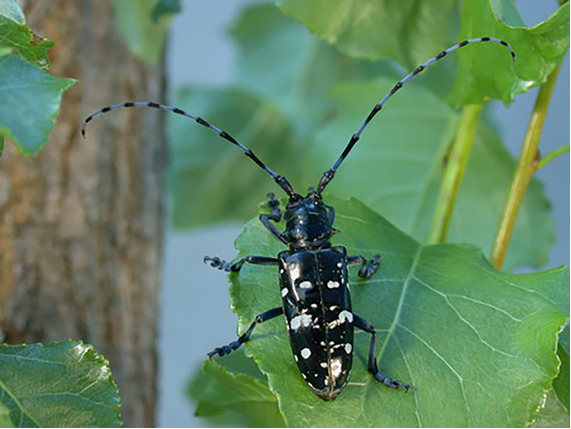
The beetle has some easy-to-recognize features:
- A shiny black body with white spots
- The body is about 1 to 1½ inches long
- Long black-and-white banded antennae
- Legs that can appear bluish in color
Signs Your Tree May Be Infested, Look For:
- Round holes in the trunk or branches, about the size of a pencil
- Chewed, oval or round depressions in the bark where the beetle lays eggs
- Sawdust-like material on the ground or in branch crooks
- Unexplained dead or dying branches
How You Can Help
- Check your trees: Spend just a few minutes looking at your trees for beetles or damage.
- Don’t move firewood: Moving untreated wood can spread ALB and other harmful pests.
- Report anything suspicious: If you think you’ve found ALB or tree damage caused by it, call the ALB hotline at 1‑866‑702‑9938 or report it online through the APHIS ALB web page. Photos and samples (kept frozen) can help experts identify the insect.
ALB in the United States
The beetle first arrived in the United States in the 1990s in wood packing material, before modern safeguards and international standards were in place to prevent pests from hitchhiking in shipments. Although APHIS has successfully eradicated ALB from several states, active infestations remain in parts of Massachusetts, New York, Ohio, and South Carolina. The fight continues, and public participation is key to protecting our nation’s trees.
For more information about the Asian longhorned beetle and what APHIS is doing to stop its spread, visit www.aphis.usda.gov/plant-pests-diseases/alb or call 1-866-702-9938.